HIBERNIA
Haining’s Irish Biketour in Eire & Round N Ireland (Arts)
INTRODUCTION
On Friday March 31 2000 Peter Haining crossed the Irish Sea by ferry from Cairnryan to Larne. He had cycled from Dundee crossing Scotland in five days and camping out each night. This leisurely mode of travel was to set the pace of the project acronymically entitled HIBERNIA, a personal discovery of Ireland as well as an intention to search for traces of Outsider Art within the landscape and people. HIBERNIA was therefore conceived as a clearly defined project with very deliberate parameters, these being geographic and academic. The original intention was to live in Ireland for a decade so that HIBERNIA would conform to this artist’s practice of making ten-year long projects – DATA (Daily Action Time Archive) – 1980 to 1989, using the identity of Pete Horobin; and Marshall Anderson – 1990 to 1999. These three ten-year projects, being essentially different in character and expression, reveal a true sense of continuum within an artist’s development in terms of creativity plus biological and psychological ageing. After five years of travelling and living north and south of the border Haining was forced to quit HIBERNIA due to ill health and a lack of financial resources for the project was always a self-funded initiative.
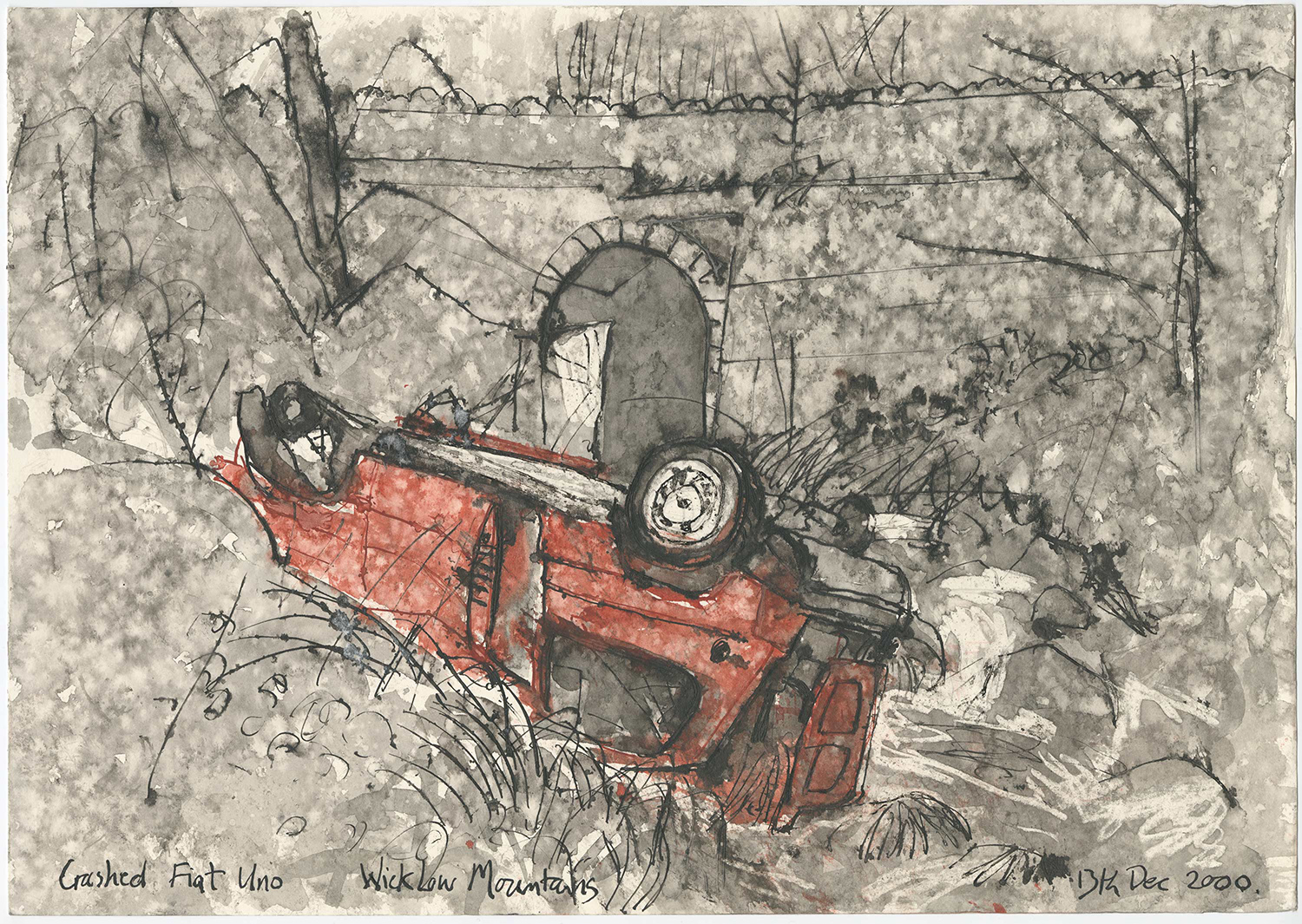
The documentation of HIBERNIA is inclusive encompassing both textual and visual material. At the core this takes the form of handwritten daily journals supplemented by a visual diary comprising A4 & A3 drawings, many of which map each temporary camping place (referred to as a haining – a lowland Scots word meaning a sheltered place). As well as these handwritten and drawn diaries there are printouts of emails, correspondence, and ephemera all of which combine to describe the physical and psychological condition of the artist as he lived and worked within the constraints of the project. The photographic and filmic content of HIBERNIA, which is strictly documentary in style, concentrates solely upon the artists and artwork under scrutiny. This documentary-styled material is supported by observational notes derived for the most part from interviews with the artists themselves, or people who knew them, or had knowledge of the folk art being recorded.
HIBERNIA therefore should be considered and appreciated as a body of work and complementary material that describes the process of travelling and researching in the field – often quite literally. The project is not only a geographic journey throughout Ireland but also an academic journey of discovery through the terminology and taxonomy behind such terms as Outsider Art, Naïve Art and Folk Art. The attached inventory reveals that the material, although numerous in content, is compact and self-contained and can be stored on a single shelf unit, however, it can also be installed in a much larger space giving expression to the 900 (approx) drawings and making use of the 35mm transparencies and digitalised interviews as projections.
Text by Peter Haining.