John Baker was born on March 21 1905, the son of a farmer from Crusheen in Co Clare. He had two brothers and one sister and when he married Maureen Hanrahan at the age of thirty they went on to raise four sons and six daughters. No one, however, in that large family showed any interest in art. Neither in fact did John Baker for like most men of his generation, with their origins and livelihoods linked to the earth, financial survival was a struggle. John Baker ran the twenty-acre family farm supplementing a meagre subsistence by labouring for Clare County Council throughout the 1950s. During the next decade he left Ireland to earn enough money to support his family by working on construction sites in England. He retired in 1970 to settle down on the small farm run by Garry, one of John’s sons.
This part of Co Clare is on the southern edge of the Burren – limestone country. A pale grey sedimentary rock that erodes into fantastic zoomorphic shapes. It is not uncommon to see these singularly distinctive rocks standing up-right in gardens or displayed on window ledges and along the top of garden walls – suggestions of surreal animals and mythical beasts. James Fitzgerald and Leo Heggarty, both near-neighbours of John Baker engaged in collecting and displaying limestone. Leo Heggarty painted his collection white and outlined the features of the implied animal or human form with red paint. John Baker too practised this type of folk art but, whereas Fitzgerald’s and Heggarty’s cottages were at the roadside, easily seen by passers-by, the Baker homestead was situated a mile up a narrow boreen away from the public’s eyes. When, at the age of 83, John Baker, a playful and fun-loving man with a zest for life, suddenly began making painted wooden sculpture the family thought he had gone crazy.
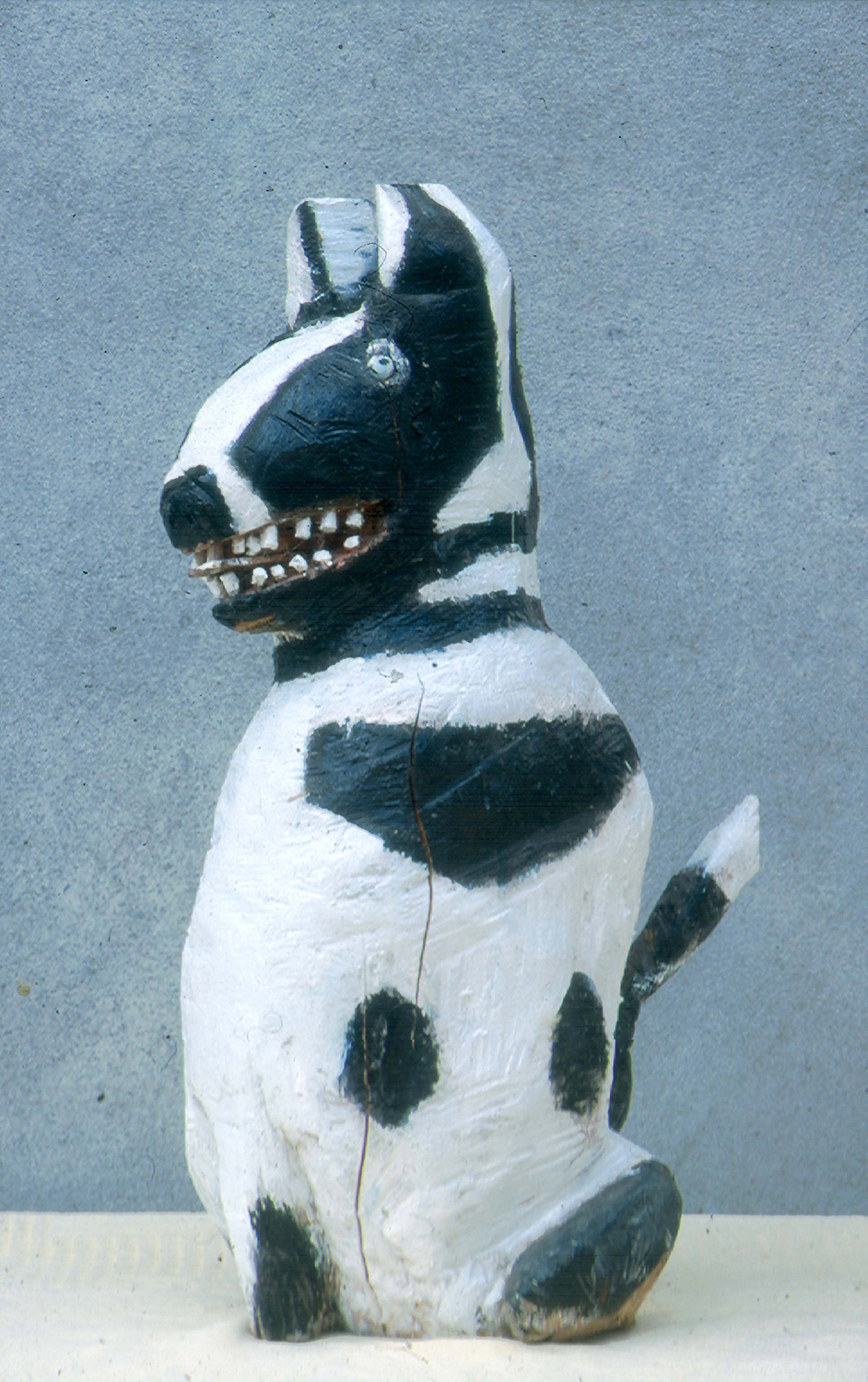
The first sculpture John Baker made is a small Jack Russell terrier. Cut from a single piece of plank, it is a typically tentative beginning using basic tools and skills. Although John’s range of tools did not extend beyond hammer, hand-saw, chisel, brace-and-bit and an electric chain saw for roughing out larger pieces of timber, his skills quickly developed exhibiting the full repertoire of his knowledge as a joiner on building sites. Few of John Baker’s sculptures are traditionally carved in the round from a single piece of timber. Instead they are constructed and articulated from carved body parts, crudely and effectively morticed together then secured by nails and glue. Where joints did not meet neatly and where extra material was required to make the form read, John filled in with cement, plaster or car body filler. A coat of paint concealed minor discrepancies. Teeth are individually whittled, painted and dowelled into the jaw. Often a tongue is similarly shaped and secured inside the mouth. Tails too are made separately. Eyes are either teddy-bear eyes or glass marbles and beads. Traffic-controlling cats’ eyes were also reinvented. In one piece, referred to as Androgenee, a tin cap crowning the head is evident. This apparently secured a wig of horse or cow hair further suggesting the figure was female supporting the theory by one family member that she was a ballet dancer. Now, her maker dead and her true identity lost, she has taken on a life of her own.
By working every day from nine to five on his new hobby, John Baker assembled a wondrous community of painted wooden figures which populated his yard and garden. Secluded and mostly concealed from neighbours and the public at large only close friends and family knew what the old man was up to. Had the route of the Mid-Clare Way not been designed to pass the Baker farm and John’s fantastic site all knowledge of his achievement would have been lost forever. And had the artist Paul Tomkins, who designed the public right of way’s brochure, not met me by one of those inexplicable twists of fate, this story would not be told.
John Baker rarely, if ever, purchased materials with which to create and construct. As a consequence many of the recycled timbers he used quickly rotted where they were situated. His large family of sons, daughters and grandchildren were constantly badgered into contributing by saving leftover household paints and anything else the madcap maker needed. John Baker’s congregation was a family effort. All except Garry, who expected his father to help on the farm instead of wasting time messing about with bits of wood, took great pleasure in John’s entertaining pastime. Sean Baker shot a short VHS video of his father’s garden when it was at its zenith. It shows a great assembly of beasts and men all instantly recognisable as inhabiting their maker’s real and imagined world. Animals were invariably left to declare their own, sometimes confusing identity while most humans were given a label made with tin, their name painted on with a brush. Most of these have become detached or faded obscuring identities with time. John Baker chose to populate his garden with the historic and famous – Michael Collins, Eamon de Valera, Monsigneur Horan of Knock, the Pope, Saddam Hussein, Charles de Gaulle and Sammy Davis Junior. He made a giraffe and a red deer stag, horses, dogs, cats, and pigs as close to lifesize as he could manage. In the centre of his universe stood the Virgin Mary. John made Virgin Marys for most of his family – at least two survive.
John Baker died in hospital in February 1998. He had taken a fall breaking his hip, sadly he did not recover. His creativity had spanned a twelve-year period of old age that most people regard as totally non-productive. His determined and creative stand against the terrors of retirement, age and criticism, in spite of being poorly equipped as an autodidact, prove that art can spring from the most unlikely sources.
After his death John’s family left everything where it stood. The garden was abandoned to neglect and decay. Nature quickly overwhelmed the fragile achievement of the old eccentric. In 2001 Eamon Baker decided to renovate his father’s cottage and instructed Garry to clear the site. A JCB was hired and all scraped, scooped and shovelled into a midden of broken wood, stones and earth. Some pieces were rescued, others escaped the JCB and survived destruction, a few, gifted to members of John Baker’s family, were carefully looked after and remain in good condition. John Baker’s legacy is that of a working-class man who, like all truly independent naives, had the courage to make his personal statement about his life and time on this planet.
Photographs by Veronica Nicolson.
Text by Peter Haining.