John Bourke
John Bourke was born c1933 and of his life very little is known other than he grew up in Kilmallock, Co Limerick and, for no apparent reason, was lifted off the street at the age of 17 and placed in custody within St Joseph’s Psychiatric Hospital in Limerick for fifty years of his life. His case is not uncommon in the south of Ireland which, under a totalitarian system operated by the Catholic Church and the State, treated society’s deviants with punitive, draconian methods. It was easy to be classified as a deviant and virtually impossible to escape from incarceration. Being held in a psychiatric ward a person was virtually abandoned, given no basic human rights and treated as a slave. To relieve the tedium of this regime John Bourke began to draw and paint using materials given him by caring members of staff who were in a minority.
After fifty years of institutionalisation John was totally reliant on the hospital organisation for his well-being and day-to-day requirements. He had no idea of self-reliance or independence, consequently when care-in-the-community schemes were eventually introduced to southern Ireland in the late 1990s, and those patients considered to be of no threat to society were released, John was placed in a hostel where he was free to come and go yet he remained totally dependent upon the art facility in the Mulgrave Centre at St Joseph’s Hospital. Here the artist in residence, Gerry Carew Hines, recognising John’s ability to draw and paint in a fluid and direct manner without prompting, encouraged him. John visits ‘his’ studio daily producing a steady stream of drawings, paintings and other projects, most of which are abandoned. Gerry organises regular exhibitions of his work which sells well in spite of John’s seeming disinterest in a commercial incentive. He would not, nor could not, organise his own exhibitions although he does enjoy the benefits of being the centre of attention along with the self-esteem he derives from them.
John Bourke’s output can be placed in five distinct themes: religion, birds and animals, Killmallock, people and pianos. All refer directly and indirectly to his past before being imprisoned is St Joseph’s. Like most Catholics of his generation he is devout. His faith and belief is affirmed through images of the Virgin Mary, Christ and angels. In drawings and paintings of Killmallock, seen from above, St Peter and Paul’s Cathedral is centrally located and depicted in a detailed, three-dimensional way not only giving it prominence but also emphasising the part religion plays in his life. Other surrounding architectural features are simplified and two-dimensional imbuing them with less significance and meaning.
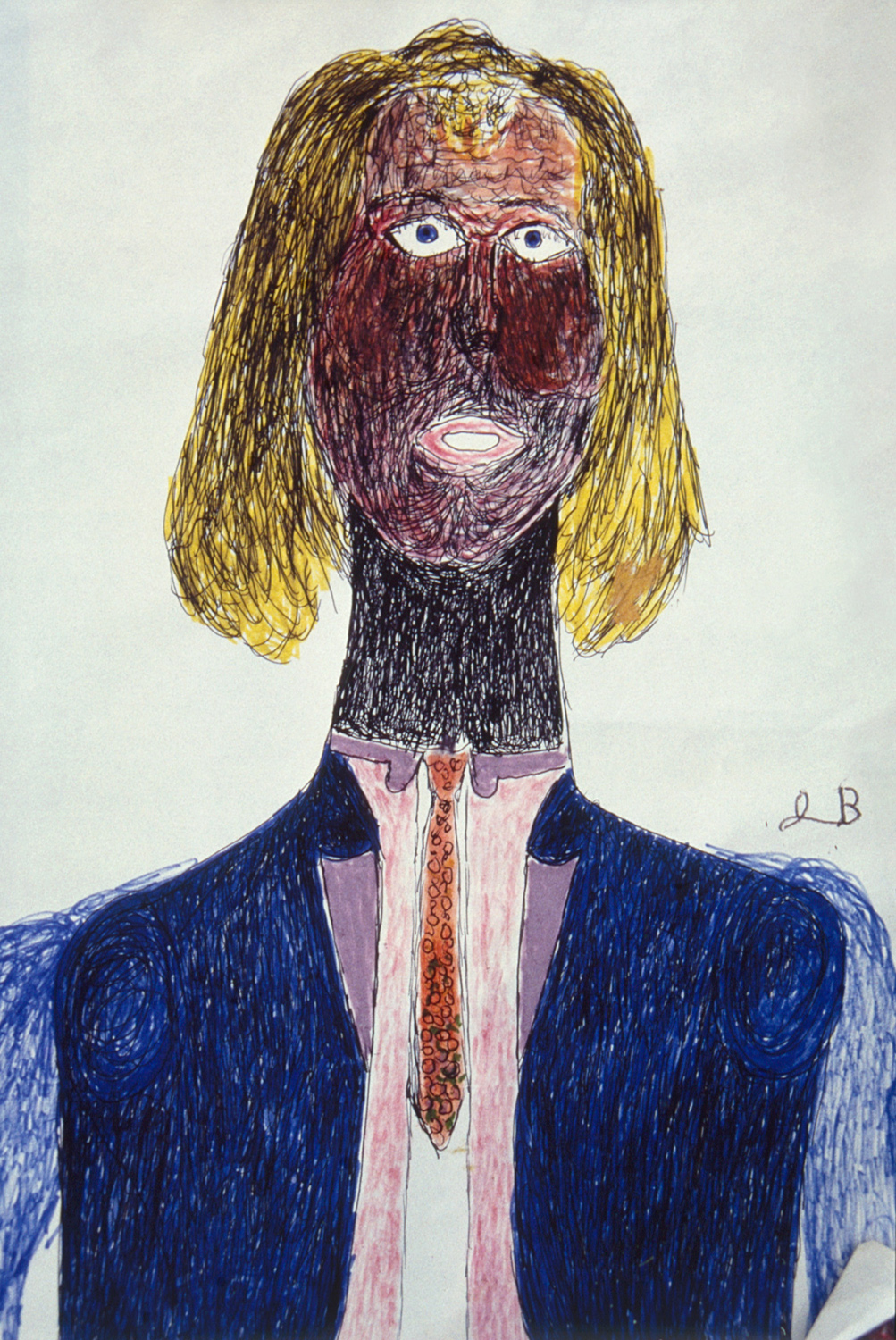
Invariably John paints male characters robed as priests, monks or Christ, which can lead to them being confused as women, however, John’s female subjects are dressed prettily, fashionably in the style of the 1940s. They either originate in childhood or from current events and television. John’s birds and animals have no clearly defined place of origin and could equally be remembered from schoolbooks, life or television. Often a single bird or animal will cram the page assuming complete importance or dominance. Pianos too are shown with this sense of scale. Monumental instruments that dwarf the pianist to such an extent that they become nightmarish.
The darker side of John’s memories is revealed subtly, sometimes disguised as humour. Like most naïve artists, who have suffered extreme institutionalisation, John’s art is optimistic and joyous, over-riding pessimism, melancholy, and bitterness or anger. His art is an escape from the horrors of the past yet occasionally an image of haunting starkness and terror appears, such as his portrait of aunt Biddy, the head of a cat, and to a lesser extent, his piano dramas.
John often draws with a biro directly onto the paper, regardless of size, not pausing for thought or consideration. Sometimes animals are shown defecating or copulating, emphasising John’s lack of inhibition and self-consciousness. He completes a drawing or painting quickly – easily. Sometimes works that may have taken days or weeks to resolve are destroyed, others are painted over. The head of a cat, captured on video, was painted over with black paint minutes after being filmed. The need to make over-rides all other considerations. This recalls what Kandinsky called the ‘inner necessity’ – the obsessive creative urge that is shared by all artists. John either trashes his work or gives it away consequently without Hine’s care and attention there would be nothing to frame and exhibit, or document and archive.
Text and photographs by Peter Haining.