John Crampsey
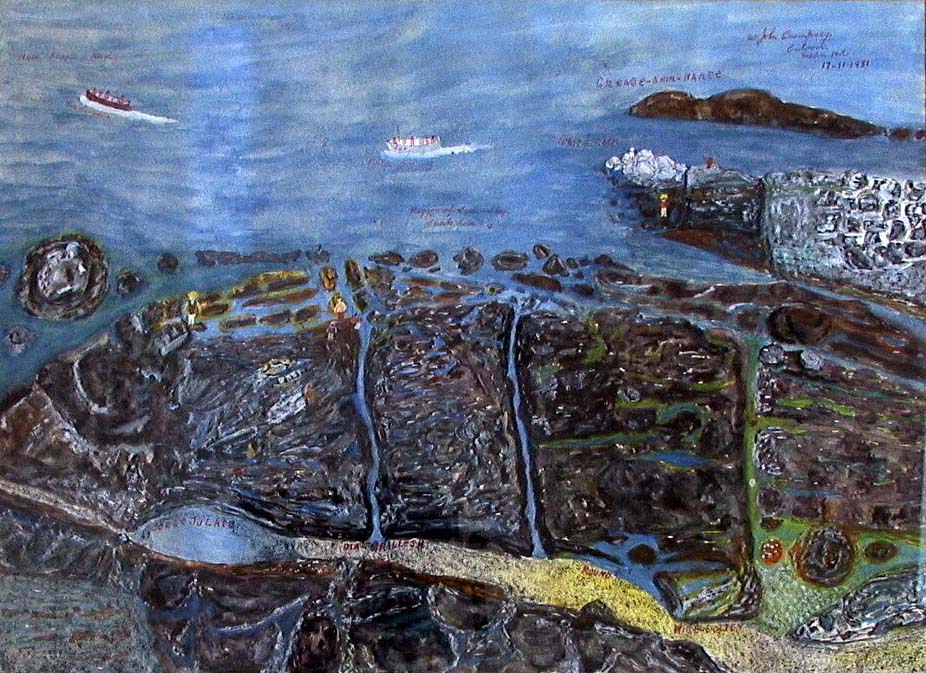
John Crampsey was born on the peninsula of Inishowen in the parish of Malin Head, Co Donegal in 1905. His father, John Crampsey, born1874, was a small farmer who lived until he was ninety, dying on April 7 1963. He married Catherine/Kate McDaid, born 1880 who lived until she was 102, dying on December 27 1981 having raised five children: John, Charlie and Paddy (neither of whom married) and two daughters, Mary Ann (whose marriage bore no children) and Bridget who married Jack Fox and raised three sons, Charlie, John and Tony and two daughters, Rose and Patricia. Born out of wedlock, John Crampsey was, to disguise his illegitimacy, boarded with his aunt and her husband at Keenagh, a small hill farm of thirty acres of marginal land. Although his contemporaries and brothers left Ireland to find employment and see a bit of the world, John Crampsey was content to stay at Keenagh, which he inherited, for the entirety of his long life. Here he led an independent, self-sufficient lifestyle without running water and electricity. He thatched his single-storey, two-roomed, stone-built cottage with adjoining byre; decorated the walk-in hearth with pebbles from the beach a couple of miles away; grew oats and potatoes; fished off the rocks; kept a milch cow and cattle and on occasion other forms of livestock; cooked on the fire and baked his own bread. He was able to sew and in later years began secretly to draw and paint. No one among his family and close friends can say with any certainty when John Crampsey started ‘the art’. His brother, Paddy, who died as a consequence of being struck by a car, was well-known as a local poet. He was published and some say John was envious of Paddy’s ability and success. Whether this spurred John’s creativity or not is impossible to know for he was a private man who hid his art away keeping it in a cheap, grey suitcase below the bed. He would only take it out if he felt confident, at ease and relaxed in his visitors’ company. A regular visitor in whom John Crampsey confided was Moira de Valera, a young doctor on placement to the Malin Head practice. When she married and continued to visit John she brought art materials and a bottle of whisky to stimulate the craic. The suitcase came out and an impromptu exhibition took place. In true naïve artist’s tradition John Crampsey gave his paintings away – especially to pretty women. Moira received three over the years. John Crampsey was on a kind of informal tourist map: renowned for living an 18th century lifestyle and having a store of local folklore, a wealth of local history, a number of humerous and bawdy stories, as well as a suitcase of interesting paintings. In 1987 Seamus O’Cathain of the folklore department at University College Dublin (UCD) visited with a tape recorder, the result being an entertaining storytelling session which mixes personal anecdotes with folkloric tales. This took place at the insistence of Charlie Fox, John’s nephew. A year later, on Saint Patrick’s Day, March 17 1988, the UCD folklorists returned, this time armed with VHS video equipment. Unfortunately a dying battery restricted the recording. However, this short piece of video is invaluable in that it shows Crampsey in his kitchen-cum-livingroom beside his pebble-decorated hearth with his grey suitcase open on his bed. One by one paintings are taken out and shown to his audience which included O’Cathain, Tom Munnelly, two pretty female students and Charlie Crampsey, John’s brother. While watching this video one is struck by the powerful connection between the paintings and the storyteller’s art. Each painting is not only a prop with which to illustrate a string of associated tales but also a map to guide the listener – to show him or her the exact locations where particular incidents occurred and where certain shellfish and edible seaweeds can be found. One cannot help being made aware of a telescoping of time, of looking back to an age when stories were told around a fire to pass away hours of darkness. This scene is timeless and John Crampsey’s innate contact with a phylogenetic memory takes us there. In the folklore department at UCD is a scroll painted by John Crampsey and assumedly presented to O’Cathain after the 1988 session. It measures approximately 18” x 40” and shows a stretch of local coastline painted in watercolour with additional topographical notes in biro pen. These include the date, 1975, and give the location as Caloort. The painted paper surface is pasted to a backing paper allowing a 3” border all around with each end tacked with drawing pins to a strip of wood. One could imagine such a scroll being carried by prehistoric hunter gatherers or 16th century explorers. John Crampsey’s paintings are not only vessels for myths, legends and historical events, they are also detailed, intimately observed, maps of his locale. His paintings too are games to entertain the viewer. Concealed in the texture of rocks and landscape features are faces, figures and animals. The artist always taking delight in pointing them out when a person failed to discover them. No one can tell with any certainty how productive John Crampsey was. Nor can they say what happened to his suitcase full of paintings. It is presumed he gave them away to visitors. He painted from memory sitting by the fireside with his back to the window. Rarely are his paintings larger than A3 so I assume he worked with a sketchpad on his knee. Larger ‘maps’ such as the one on brown wrapping paper were probably drawn at a table. Quote from the map on brown paper: ‘The flour ship Daniel Morris, was wreaked in on the Diamond Rock year 18 and 76. Mary Ann, the furniture ship, was wreaked in at the Sloak Rocks year 18 and 83. Twilight, the timber ship ran aground on the Saney Banks of the Bar Stran year 18 and 89. The flour that came off the flour ship was the first flour baked at Malin Head. The Mary Ann broke up in two, one part of her lies sanded below the Twilight on Bar stran, the other half in Tra Breige.’ Through this work we learn far more about a piece of landscape, or seascape, than from a work by a typical pictorial painter who would use one fixed perspective offering nothing more than a superficial view like that of a postcard. John Crampsey was an artist, historian, gazetteer and cartographer not to mention farmer, fisherman and seanachie. John Crampsey became ill towards the end of life and was forced to give up Keenagh and go live with his brother Charlie across the valley. He died on October 19 1992 at the age of 87. He had remained a bachelor all his days and is remembered with affection by friends and family. Text and photographs by Peter Haining.