John Conneely
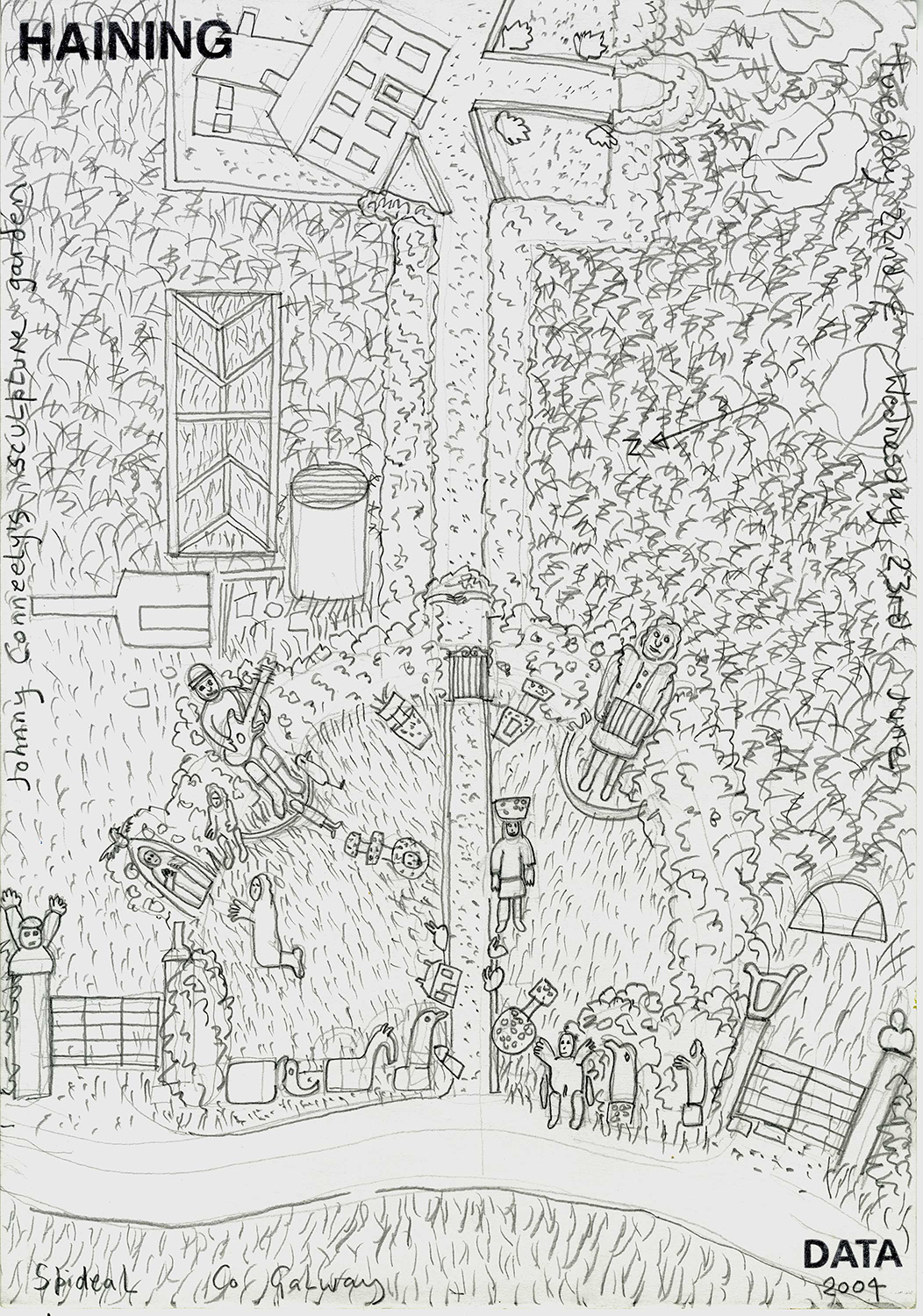
John Conneely was born in 1916 in the Spiddal area of Co Galway and became a farmer holding a few acres with two cows and five horses. In 1960 government grants were made available to small-scale farmers enabling them to diversify into producing tomatoes. The legacy of this is to be seen on John Conneely’s land – the ruinous steel framework of a large greenhouse with a boiler-room to run the heating system. The scheme got off to an optimistic start but in 1962 Hurricane Debbie blew out all the glass and, with no insurance or finance to make repairs, was condemned to obsolescence and decay. John Conneely died from cancer in 1999 his wife having died eleven years previously. They raised two sons and a daughter. The eldest, Sean, born in 1955, now lives in a contemporary bungalow sited on his father’s land, just downhill from the unique sculpture garden old Johnnie created. Sean Conneely could not say when his father started to make human figures, birds and animals from cement but he could tell me that John Conneely’s creativity began with topiary. Old John built the original family house, a six-roomed, two-storey dwelling commanding a south-facing view of Galway Bay to the hills of Co Clare and set out a garden bordered with privet hedges into which he cut the shapes of dogs and a kangaroo. The garden gate was set in an archway over which stretched two arms, hands clasped in friendship, with the words Cead Mille Failte. Constructed with cement, these may represent John Conneely’s introduction to sculpture. In front of the garden gate is a semi-circle of ground, its outer perimeter described by a metre-high wall covered with shrubbery. A short path from the boreen to the gate divides it in two equal halves each bordered with small stones. This horseshoe site contains old John’s sculpture garden which lay neglected and overgrown until young Sean decided to do up the house in 2003 with the intention of renting it. Although neglected, John Conneely’s sculptures were not unloved by neighbours and family. The fact that they were unmolested and not vandalised is testament to the respect they held. Any wear and tear seems to be from weathering and accident. Two agricultural gates flank the sculpture garden. These are set in concrete posts upon which are sited a shamrock and an Irish harp to the right, and the head and torso of Packie Bonner to the left. He is shown with his two arms reaching above his head for the ball – now absent. Pat (Packie) Bonner’s goalkeeping career began at Celtic Park when he was 17 in 1978 and stretched to 1995. He also kept goals for the Republic of Ireland in the European Championships. About fifty meters further on another gateway into a field is marked by the figure of Poteen Man sitting on the gatepost. Away from the shelter of the garden, he has been more ravaged by wind and weather yet holds on to his composure and humerous caricature. John Conneely’s method of construction was rudimentary and effective. He cast hands by filling rubber-gloves with cement and feet by pouring cement into rubber-boots. Other body parts were fashioned over an armature composed of whatever was available. No carving is in evidence instead forms were modelled, assembled and constructed. An elephant, now collapsed under its body-weight, was part-made by modelling its body over an oil drum and pouring cement into a police ‘no waiting’ cone – the lettering embossed into the elephant’s head. Sean recalls his father having a bag of teddy bear eyes which suggests John must have gone to the trouble of sourcing these with large-scale production in mind. In some cases eyes were made with pebbles and other details emphasised with rivets, washers and nails. Tongues were made from red-pink plastic. A cloth hatband is still discernible on the larger than life-size Guitar Man, and a leather strap is all but rotted away on the accordion of his fellow musician opposite – an indomitable giantess built into the wall, her squeeze-box made from cement blocks. Rabbits and hedgehogs look as though they have been cast from jelly moulds. Giggles is a child-sized figure in a wheelchair, so-called because his nodding head makes his penis (a piece of metal) jerk up and down. One could, instead, use his penis to nod his head. When I first visited the overgrown site in June 2002 a head and two hands sticking up from a sea of thick grass were barely visible. I called this the Drowning Man – a metaphor for naïve art in Ireland. A year later he was gone – victim of Sean’s mowing. In 2004 Sean rented his father’s house to a young couple who claim affection for their unique garden fixtures. Sean is proud of his father’s modest achievement but has little commitment and perhaps no skill to carry out necessary repairs to maintain the robust yet delicate sculptures many of which are showing signs of damage and decay. In Ireland there is no agency with responsibility for the preservation of folk art sites, be they sculpture gardens or decorated cottages. Neither is there a collection policy for naïve art, the majority of which is destroyed for reasons already mentioned. The future of John Conneely’s sculpture garden is sadly predicable. It will gradually and inexorably decline until it reaches a stage of no return. At this point the next generation, so far removed from any sense of loyalty to its maker, will scrap it completely. Text by Peter Haining.