Moscow Joe McKinley
In 1979 Marcus Patton, a Belfast-based architect with a keen interest in vernacular buildings and unusual expressions of creativity in the landscape, stopped in Glenloy, Carnlough, Co Antrim, to photograph concrete-built structures in a garden. It was February and there was a dusting of fresh snow on the hills. He did not meet the maker of the architectural facsimiles and returned some weeks later to take more photographs, possibly hoping to meet the maker. From the evidence he saw, Marcus deduced correctly that the owner of the property was a milkman for he photographed his green milkvan. He noted too that the small garden in front of the cottage was decorated with mosaic constructed with shells and pebbles from the beach.
This then is the first documentation of the creative activity of Joseph McKinley, ‘Your Friendly Local Milkman’ who is survived by a few traces only, these being:Three topographical paintings with collaged details in the Londonderry Arms Hotel, Carnlough.Two are located in the entrance foyer, on the left by the main door.The upper, Carnnlough 1888 – Jewel of the Glens, is signed Joe McKinley ‘Your friendly local milkman!’ 1988. It is in a graphic naïve style, a schematic scene showing the busy harbour and undeveloped countryside. The scene is broken up by bubbles with handwritten text and a larger circular inset showing the Falavee Pier 6 miles away. There is a circus tent pitched in one of the fields and the site of the crashed US bomber is also shown. Although the whole scene is of 19th century industrial Carnlough, the US bomber crashed in 1942. Joe gives the year as 1943 in the painting. Might we also assume that the circus too is a personal memory that does not accord with 1888.The lower painting is more topographical in character – Carnlough, a friendly village. Signed Joe McKinley, ‘your friendly local milkman made this 1984.’ There is mention of Dunedin Dairy. The vertical work is essentially a map of the village with many collaged inserts that are either hand-painted and hand-written or cut from magazines. The inserts give information about places of interest. The whole could be described as a tourist guide-map.The third work that once hung over the fire in the large public bar and has now been hidden in a cupboard, is a heavily collaged work the theme of which is the US bomber crash of 1942. The main piece of collage, a photocopy of a newspaper report by Tim Gracey dated 24.8.1942 entitled, The Disappearance of Flight LV 340 over Carnlough. Beside this is stuck a ‘Genuine part of the bomber my son found in 1978.’ There are 8 square format colour photos showing the public walkway into the glen. The work comprises what one can only assume to be significant aspects and events in Joe’s life – fanzine pics of James Stewart, John Wayne, local fiddler Jim McKillop, the sinking of the Titanic, an Aeroflot tissue memorabilia of flight back from Moscow 1987. The whole is signed Josef Alphonsus McKinley, Glens of Antrim Lover, 1.6.1988, ‘Remember me when I Ascend!’One topographical painting with collaged details in the medical practice, Glenarm, Co Antrim.One coin-encrusted walkingstick, now in the possession of his older daughter, Carolyn.One hand-painted sign close to the site of his, now demolished, cottage in Glenloy:If There Is a Paradise on Earth – Here It Is.One hand-painted sign near Garron Point, Co Antrim:Just What is This Spike For?One inscription on a large rock at the roadside near Garron Point:Joe McKinley 1971Various letters sent to friends and business associates.
Joey McKinley’s creativity commenced in the mid to late 1960s and continued unabated until he died suddenly of a brain haemorrhage on 18 May 2003. His creativity began with painted pebble souvenirs of Carnlough and progressed to ornamental garden fixtures:A concrete garden bench built into the wall of his yard.Various mosaic features.Small architectural features.The reconstructed frontage of a gardenshed comprising three archways decorated with pebbles set in cement.
Indoors his process of decoration covered the walls and ceiling of his ‘den’ which doubled as office, bedroom and studio. It also spread to an area in the hall around his telephone.
The four topographical views mentioned above, all made between 1984 and 1988, combine collage and poster paint and are crafted with a precise and careful hand. They are articulate and reveal a keen eye for historical detail. Humour too is evident. A playful element creeps in when the viewer is asked to spot ‘the seven deliberate mistakes’, which would be impossible for anyone without an intimate knowledge of Carnlough.
On the wall, above his bed, hung four framed works which, evidently, were made by Joe during the 1980s. One was a painted scene showing a golfer among trees with a lake in the background. It is signed J. McKinley but not dated. Another was a series of eight painted local postcard-like scenes with captions beneath each. Beneath this hung a cartoon showing a man and woman in dressing-gowns and night attire entering a diningroom with the caption:Well You Did Say It Was Home From HomeTo the left of this was a small cartoon-like painting of well-dressed people in the doorway of a lift hoping the garbage collector is not going to crush in beside them. The caption reads:Hold On, Wait For Me!.
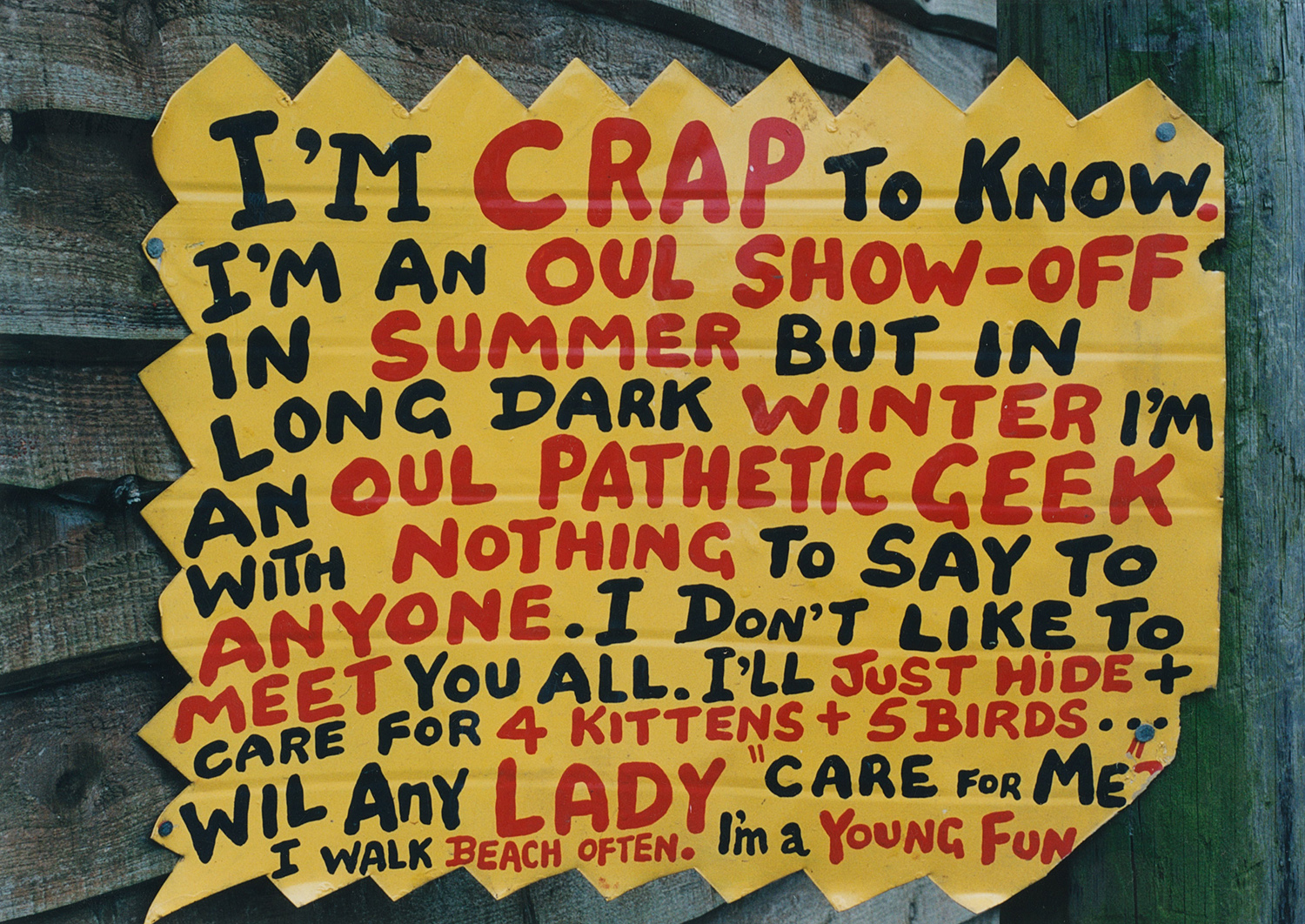
To my knowledge, the next person to document Joey McKinley’s creative activity through a series of black and white photographs was Rodney Ritchie of Ballymena in 1997. These show that, by this time, Joe had begun to fill his yard infront of the cottage with an ever-evolving installation of found objects, bric-a-brac, reclaimed detritus and flotsam and jetsom much of which was mythologised through hand-painted signs made from recycled metal and board.
Rodney’s photographs represent the beginning of a rewarding relationship between Joey and Diane Wilson from Ballymena, a friend of Rodney and an art student at the University of Ulster in Belfast. In the late 1990s she cultivated a close friendship with Joey, the zenith of which was a talk he was invited to give to staff and students in the fine art department. This was part of Diane’s dissertation in Outsider Art and was approved by her course tutor, David Ledsham. It took place in the spring of 1999.
In 2000 I happened upon Joey’s, by now, complex array of discarded and rescued junk which included two ‘art cars’: a red Astra purchased for Gemma in 1973, and a white Mitsubishi. The latter being road-worthy. I visited Joe on five occasions; 1st April 2000, 2nd November 2000, 5th July 2001, 26th January 2002 and 28th February 2002 documenting his activities with a series of colour photographs, an hour-long video, and 35mm colour slides. His work featured in an article commissioned by Circa magazine, Exploring the Margins, published in spring 2001. I also showed his art in lectures and mentioned it to anyone whom I thought might be interested enough to visit him.
John Matthews, a fellow student of Diane Wilson and a member of Catalyst Arts in Belfast, curated an exhibition of outsider art in 2002, Inside Out, As well as showing slides he had taken of Joey’s installation he invited the outsider artist to talk about his work which he did on 9th August 2002. Joey appeared with a kitten on his shoulder and was attired in his familiar costume.
Lorna McNeill, a native of Carnlough, and Stephen McDonald made a short documentary film, The Great Exhibitionist, for Ulster Television in 2002. Joey also featured in other magazine and newspaper articles as well as a spot on Ronan on the Road, an Ulster Television programme with Ronan Kelly.
By the time Joe died in May 2003 he had cultivated celebrity status and developed his art to a level of assuredness and complexity that communicated very directly to all who encountered it and engaged with its maker. Moscow Joe’s art was admired and envied by many artists for whom it represented an uncompromising freedom of expression, achieved by an uninhibited, extrovert behaviour supported by an incisive wit and wide general knowledge. Most artists recognise Moscow Joe’s courage of conviction, affirming that few of their number will ever attain Moscow Joe’s status of uniqueness for he was non-conformist and truly ‘outside’ society’s social codes in every sense.
Text and photographs by Peter Haining.