Dr Judit Bodor is a curator, researcher and currently Programme Director of the MFA Fine Art and Curatorial Practice (Art & Design) at the University of Dundee. She leads the research network Curating the Digital Attic Archive with Dr Roddy Hunter from The Glasgow School of Art.
Since completing her PhD, Bodor's curatorial practice research focuses on enhancing the accessibility and visibility of artist archives through living archival methods such as activation and remediation. These methods integrate archival research, oral history, exhibition-making, and infrastructure development to sustain long-term visibility and scholarly engagement with artist archives.
Methodologically, Bodor's research distinguishes between activating 'living archives' involving curatorial intervention to revive a dormant practice, and 'active archives', in which archiving itself constitutes a generative, experimental practice. This distinction is exemplified by the Attic Archive, where archiving was a generative mode of artistic production until the material entered into institutional collections.
Bodor's other projects and exhibitions connecting with artist archives include archivuminternetwork: The 30 Years of artpool.hu, Budapest, 2026, Left Performance Histories nGbK, Berlin, 2018, and Silent Explosion: Ivor Davies and Destruction in Art, National Museum Wales, Cardiff, 2015-2016. She is a Trustee of The Alasdair Gray Archive in Glasgow and was a Scottish advisory member of ART360 Foundation.
An Attic Archive 'correspondent':
Bodor's relationship with the Attic Archive dates back to 2005, when she visited Peter Haining, then administrator of the DATA Attic, to see the collection he offered to Artpool. Bodor's report and recommendations led Artpool to accept material from the Attic relating to the 1980s and international Mail Art networks, along with related material. This part of the Attic Archive was eventually moved to Artpool in 2010 by the artist himself, who also wrote an accompanying essay From A to A - New Directions. In this Haining wrote "It was always the ambition and purpose of The Attic Archive to resist becoming a dead-ended resource or a cultural cul de sac in which the material preserved atrophies. One way to prevent this occurring is to ensure that the material in the archive is available for the making of new works." This quote now underpins the work Bodor leads with Hunter and the research network Curating the Digital Attic Archive.
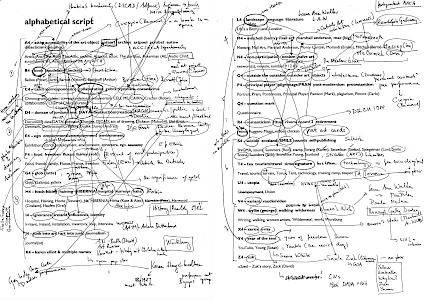
When appointed as a Baxter Fellow in Curatorial Practice at the University of Dundee in 2020, Bodor returned to researching The Attic Archive at the University's collection. She also contacted the artist – operating as haha at the time – to meet for a series of oral interviews during COVID with him at the Scottish Oral History Centre, Edinburgh. This 9-hour conversation followed an alphabet put together by Bodor and haha to explore the entirety of the archive. The transcribed, annotated, illustrated and edited document is now deposited in the University of Dundee Archives. The Alphabetical list, marked and annotated during the conversations, became key for navigating the archive, while the conversations are now a key resource for interpreting items selected for the platform.
In 2021, Bodor led a Royal Society of Edinburgh–funded workshop project, What is a Living Archive? Curating the Unruly Materiality of Contemporary Art, including a series of thematic workshops facilitating knowledge exchange among artists, archivists, curators, and conservators about 'unruly' archives. The last workshop in this series, co-developed with Dr Roddy Hunter, was titled Resisting Recuperation: Articulating the unruly politics of Artist Archives through open-source practices and explored how open-source practices and technologies could address the preservation challenges arising from The Attic Archive's geographical dispersal and radical approach while maintaining its anti-institutional, autonomous ethos. This workshop brought together, for the first time, the archivists who are current custodians of the dispersed Attic Archive and as such a direct antecentent of the research network project.
alphabetical script